Teaching Design for Sustainable Living series
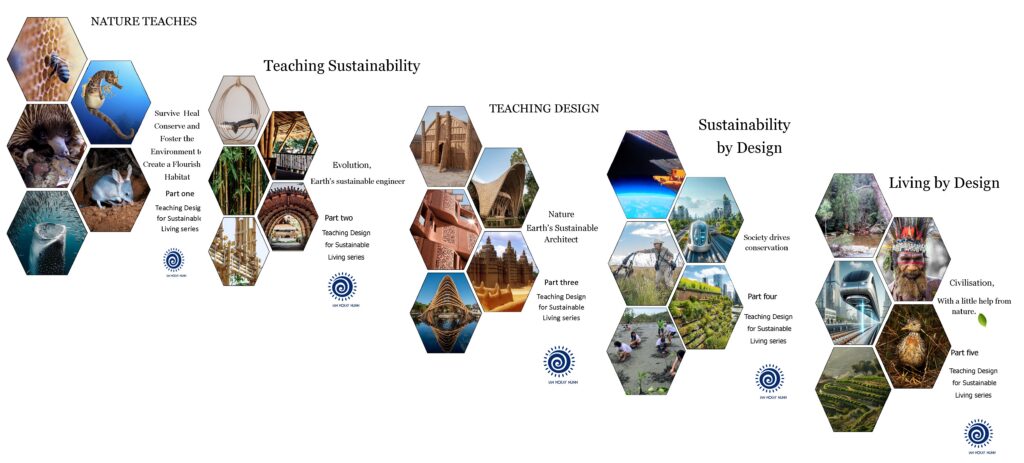
NATURE TEACHES book one: Survive, Heal, Conserve and Foster the Environment to Create a Flourishing Habitat.
A student Workbook is included with each book of the series.
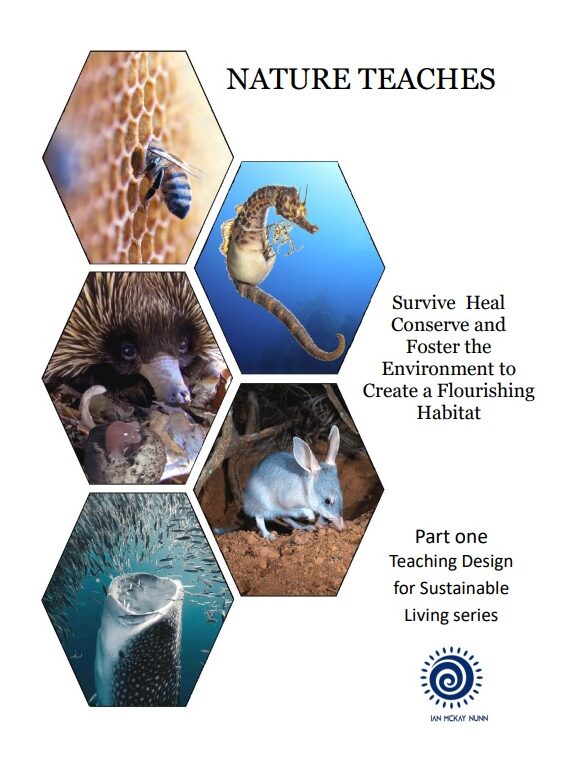
For teachers wanting to address global warming issues with sustainable alternatives for individuals and communities.
Nature has evolved through climate variations; the survivors show their ability to adapt.
Teaching a strategy to align individual needs and environmental issues to sustainable eco-systems.
We have real-life environmental solutions to all environmental impacts. To match the social crisis of:
- Student despondency
- Leadership vacuum
- Politics of vested interests
With 8 billion people demanding a modern way of life sustainable food production systems are imperative as are:
- Means of shelter,
- Means of production,
- Resource extraction
- Energy supply
- Material resource management
Book one: Nature Teaches
Identifying with your locality. Be ready to play your part in a sustainable world.
- Part A The Scale of the Problem – Human impact
- Part B Information Overload – What are the local needs?
- Part C Self versus Community
Solution overview – Knowledge and experience of location and habitat
- Our ecosystem
- Intention to teach
Solutions for a Sustainable Life – Making people see they are the problem
- Human Impact – Consuming more than we can replace
- Local needs – A response that is tailored to your needs
- Native habitat versus agriculture
- Ecosystems accommodating the interests of the stakeholders
- Bottom-up organisation
Case studies: Examples of the application of natural phenomenon
- Macadamia Plantation in the Big Scrub
- It is What they are Growing In
- Indigenous Australians have an ancient method – Biochar
- Emissions curbed in Agriculture
Design intent – Aims and process
Workbook one ― Connect to Nature
1. See our world, location, habitat, ecosystem, and biome
2. Your five senses, task: Identify a place, make notes, sketch.
3. What do you see, wherever you are? Task: environment, organisms, surroundings
4. Communicate through drawing
- Task one: take a line for a walk
- Task two: study of a bud
- Task three: study of a grass
- Task four: Plant study, a dandelion
- Task five: Insect study
Representation of Natural Life Forms
- Task six: A brushstroke to painting from nature
- Task seven: Painting; value studies
- Task eight: The old Magician
- Task nine: Nature studies; flowers and fruit
- Task ten: Colour studies of plants: leek stalk
Design brief: Protection from introduced species
- Colour studies of plant development sequence
- Colour design: complementary colours
- Colour studies of birds from nature and imagination
Design brief: beneficial species in your habitat
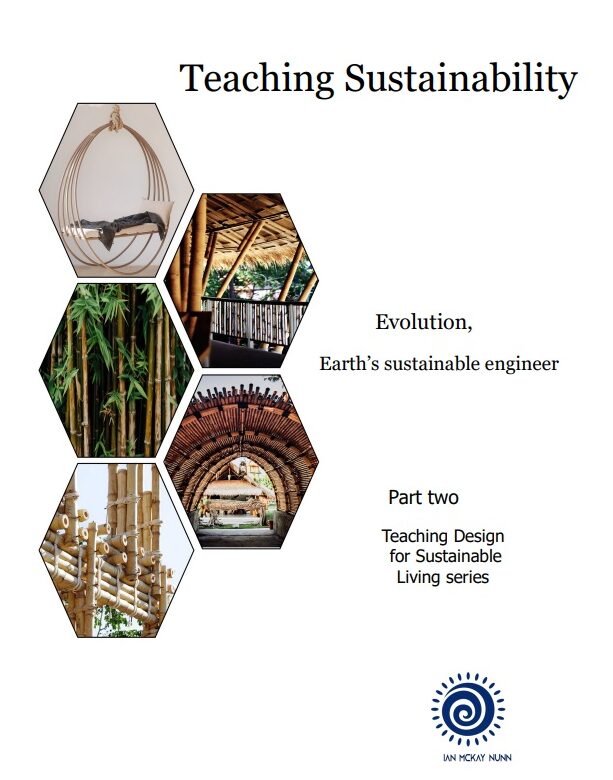
Book two: Teaching Sustainability
Our enterprise and how nature can ameliorate environmental systems
Carbon-based Life
- Energy: coal, oil, gas
- Carbon cycle
Climate Changes with the Seasons
- Climate changes everything
- Resources, demand for oil
- Human domination
- Carbon emissions, Fires
- Climate crisis, what can we do?
Greenhouse Gases
- What is the greenhouse effect?
- Atmosphere, Climatic influence
- “Carbon”
- CO2 equivalents, water vapour, methane, nitrous oxide, CFCs.
- What can we do to reduce GHG emissions?
- Ozone layer
- Methane, sources and sinks, mitigation and food.
Teaching — Belief in what you offer matters
- Sustainability, conservation, meaningful life
- Doing Teaching, The connection,
- Commitment, ownership, research
- Topics, lesson plans,
- The designer, the individual
- Assessment
Food and Agriculture
- Sustainable settlement
- Fertiliser, Crops, Soils, Bio-char
- Seaweed to combat methane contribution
- Plant adaptation
- Water, Desalination, Water collection, Waste
- Environmental impacts of producing food and land use
- What we can do to reduce human impacts
Forest Habitats
- Forests can save the planet
- Soil biome
- Carbon and Nutrient cycling
- Microorganisms in Soil
- Fungi, The Rhizosphere
Workbook two ― Why study nature?
- What to study?
- Lichen
- Drawing from nature: task 1 Texture of natural surfaces,
- 2 Can’t see the forest for the trees,
- 3 Natural forms,4 Transformation of natural forms,
- 5 Man-made objects
- 2 Can’t see the forest for the trees,
- Design brief: Resting place
- Drawing task 6. Drawings based on wood
- Graphic task 7. Natural structure rubbings and collage
- Graphic task 8. Expression of wood forms and composition
- Drawing task 9. Landscape studies of trees
- Drawing task 10. Tropical rainforest
- Design brief: Habitat for local endangered species
- Drawing task 11. Landscape; study of farm buildings
Design brief: Shelter – Nature becomes architect; found materials.
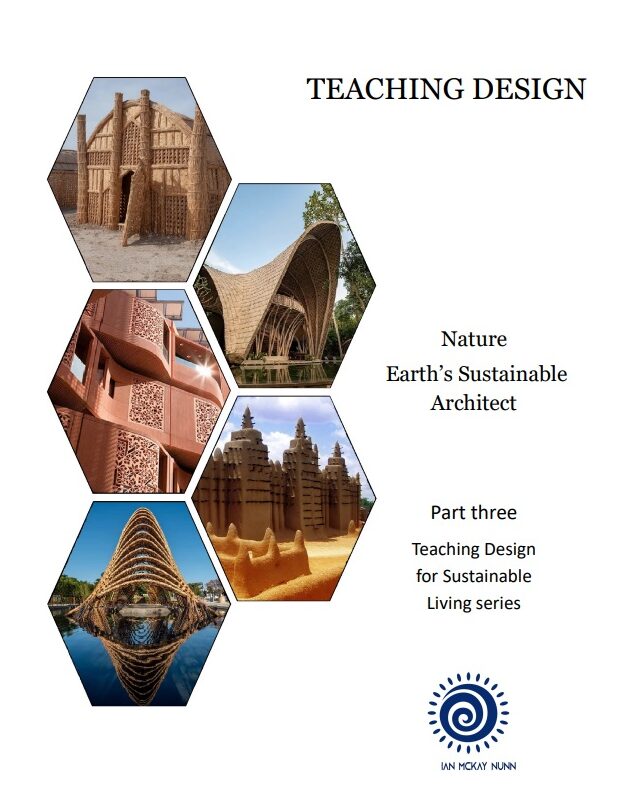
Book three: Teaching Design
Material Choice – Nature, Earth’s sustainable architect
- Production has an environmental impact
- Life-cycle of products / Reuse
- Material emissions, technical improvement
Building Design for a Sustainable Environment
- Earth as a building material
- Guidance on how to build using earth materials
- Earth home design
- Site preparation
- Foundations
- Integrating systems
- Framing
- Roofing
Plastic Pandemic
- Pollution
- Recycling
- Social and health implications
- How much PET plastic is out there?
- Who can make the changes we need?
- PLAN B – Plastic Reuse
Energy from the Earth
- Civilisation needs energy
- Crude oil
- Alternate Energy
- How Geothermal Energy Works
- Geothermal Power plants
- Application of Geothermal energy
- Economy
- Benefits of Geothermal systems
- Challenges for Geothermal systems
Sustainable Energy for All
- Distributed Renewable Energy
- Renewable Energy Systems: Types and Structures
- Solar Power: photovoltaic
- Wind
- Hydropower
- Biogas Energy
- Geothermal Energy
- Renewable Energy Impact Zero?
Building Services Powered by Nature – Water, Power and Waste
- Appropriate Technology
- Stand-Alone systems
- Water Collection
- Electricity – power supply
- Renewable Energy Systems
- Remote Area Power Systems
- Hydro Power
- Methods of waste treatment
- Passive Solar Design
- Vertical Greening
Workbook three – Designing for a Future [Resourcefully]
The Islamic Renaissance
Projecting your ideas: structural drawing, rendering
Drawing exercises: task 1 Shapes that deliver an impression
- Structure of running water
- Urban landscape Architecture drawing to linocut
- Landscape studies
Design Brief – The Wadi
Drawing exercises: task 2 Perspective training
- Architectural studies
- Hanging Garden
Conductivity or Insulation: materials analysis
Design task: Shed Refurbishment
Design brief: What to design for a Resourceful Future? Ask your Community
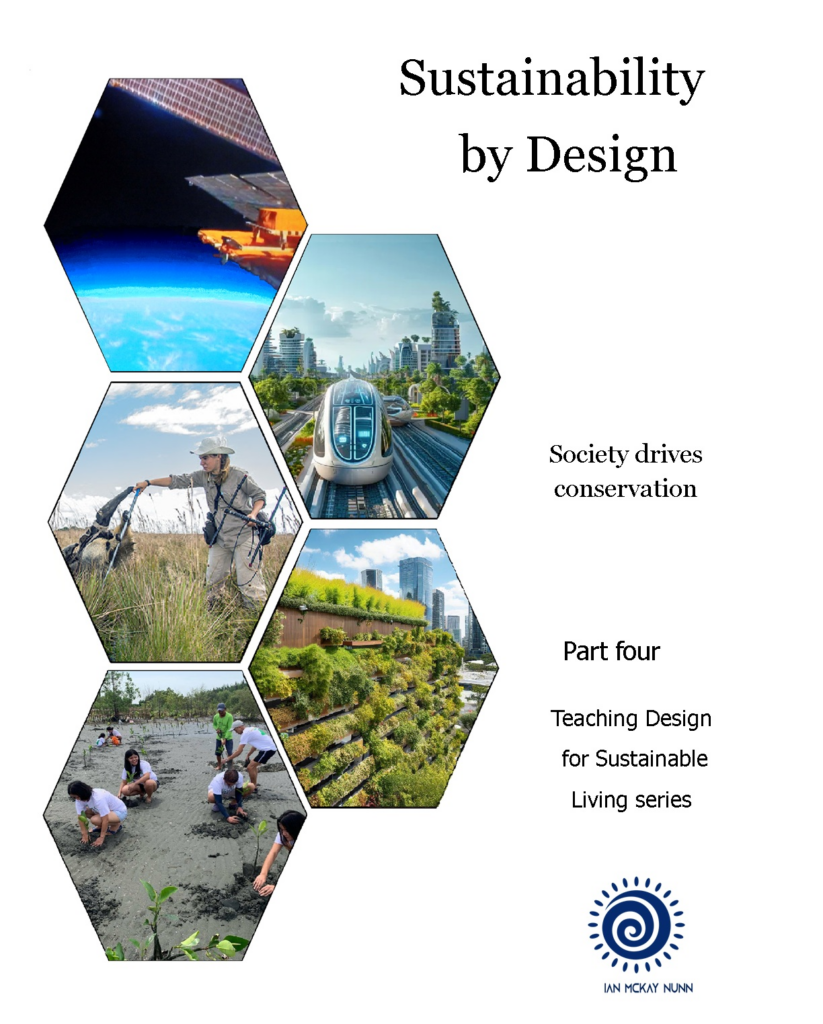
Book four: Sustainability by Design
Commerce Cities – design for a sustainable civilisation
- Infrastructure for Trade
- Environmental impact of supplying raw materials
- Roads
- Predicting environmental impacts
- Social cost and social responsibility of extracting raw materials
- Endangered and endemic species
- Transition of the Built Environment
- Greening of cityscapes, Vertical gardens
- Recommendations for the Extraction Industry
Methane: the unseen fuel
- Why is methane a threat?
- Exploration by fracturing the Earth’s crust
- Sacred site protection?
- Natural gas extraction, unwanted industry, enforced by federal politicians.
- Desperation of a gas-fired recovery plan
- Toxic water fears
Methane Emissions Naturally
- Methane matters; it accounts for 25% of climate warming.
- How Wetlands emit methane: anaerobic or hypoxic conditions, fermentation by microorganisms.
- Environmental factors: wetlands benefit water filtration and flood mitigation.
- Human development of wetlands reduces the present capacity to store 20% of all carbon.
- Bacterial ecosystems in various wetlands consume methane.
Mitigation of Greenhouse Gases
- Why reduce greenhouse gases
- Mitigation – what is being done?
- Renewable energy like solar, geothermal and tidal will reduce emissions driving climate change.
- Reducing greenhouse emissions through individual action – monitoring our carbon footprint.
- Revegetation to remove emissions – Establishing vegetation to enhance biodiversity, water catchment, waste services, dedicated carbon crops, farm forestry, renewable bio-energy crops, and fodder shrubs has the potential to sequester, or remove from the atmosphere, greenhouse gases over South Australia.
- Carbon sequestration
- Sustainable land and water management
- Carbon offset projects
- Imperative to adapt worldwide; small island developing states (SIDS) are vulnerable to extinction.
Ecologist vs. Economist
- Traders and pastoralists introduce invasive species
- Costs of Native Habitat removal
- Inherent risks of monocultures
- Impact of agriculture on our environment, and livestock-to-native imbalance.
- Environmental footprint of food production
Wild Native Habitat
Plant and animal species are more threatened by urban sprawl, industrialised agriculture, habitat loss, invasive predators and climate extremes. Extinction rates climb, and we do not know what we are losing. We do: wildlife and our sustainable ecosystems.
Case studies of species trying to adapt to a changing habitat.
- Armadillo
- Giant Anteater
- Mountain Gorilla
Carbon Capture / Carbon Credits
- Soil carbon projects, Australian government pledge to be carbon neutral by 2050.
- Methane emissions accelerate global warming
- Nutrients for food production, phosphate shortage.
- Restore soil structure, biochar production techniques.
- Soil carbon sequestration, the natural players, the fungi broker
- Iceland, carbon-neutral thanks to geothermal power generation, now hosts the first commercial direct air capture.
- The world needs to both reduce future emissions and remove as much as 12 billion metric tons of CO2 annually by mid-century.
- Plant more trees ? “It’s increasingly clear that planting trees and relying on farmers and soil carbon is not enough!
- How does Direct Air Capture work? Storing the carbon
- Technologies with relative cost and complexity
Workbook four – Fuel for Thought – Products are made from materials that come from resources in a habitat and return as waste products and byproducts
Nature studies where we represent pictorial elements: arrangement, structure, rhythm, form and colour.
- Air is the vehicle for the oxygen we breathe. Water is the other vehicle of life: – brushstroke to painting an aquarium.
- Trees breathe through their leaves.
- Subjective colour; the seasons interpreted in colour.
- Prehistoric creature still survives in this world; Nature study – reptiles – graphic representation.
- Endangered creature just surviving, poster design.
- Origin and transformation of shapes
- Structural image: positive and negative forms
- Prehistoric creature still surviving.
- Bovine nature study
- Byproducts: methane emissions
- Nature study: birds
- Analogous colour in still life subject
- Plastics infiltrate nutrient cycles: man and animal.
Composing in colour; waterscape.
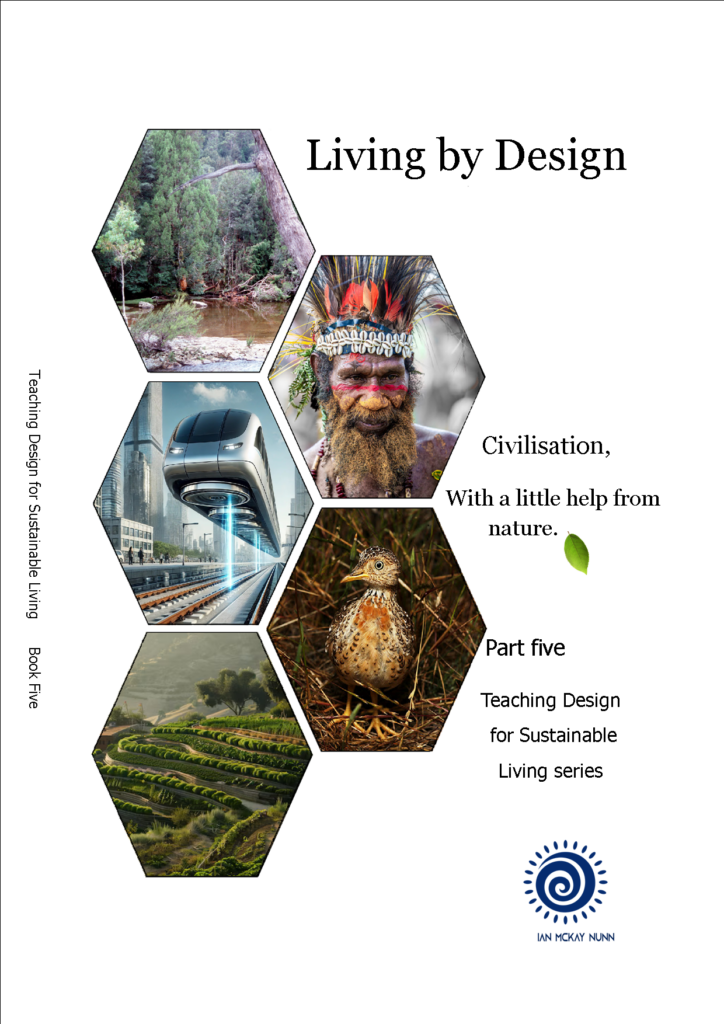
Book five: Living by Design
Civilisation, with a little help from nature
Designing with Indigenous Cultures 101
Our ancient custodians consider themselves a contributing part of the habitat. Colonists believe they can extract whatever they want from the land.
Indigenous Australians have been engineering the landscape using technological and philosophical knowledge systems in a deliberate response to changing social and environmental circumstances.
Forests Change with Climate
The northern conifer forests are losing pine and birch species, while beech and oak are likely to survive in warmer habitats.
Severe weather events are wreaking havoc across all continents:
- Drought
- Storms – wind and subsidence
- Wildfires
- Invasive species, fungi and insect infestation.
Ocean Currents
Dominating the Earth’s surface, the oceans do absorb atmospheric heat and CO2, but like all equations, there is a limit. The influence of Climate Change is evident in;
- Acidification
- Coral bleaching
- Frequency and extremes of weather events.
- Changes in oceanic currents.
Design for a Sustainable Future
The balance of life on Earth is at extreme peril. The human impacts that need to be ameliorated;
- Industrial agriculture
- Mining terrain devastation
- Consumption of natural resources
- Waste of consumables, especially plastics
Appendix U.N. Sustainable Development Goals
Unleashing the Potential – Navigating Environmental Challenges
By incorporating interdisciplinary communication, teachers can bridge the gap between theory and practice, allowing students to apply their knowledge to real-life situations. Practical experience deepens their understanding of environmental challenges and empowers them to become active participants in finding solutions. Engage with the local community and stakeholders by establishing partnerships with global environmental organisations, community leaders, and parents.
Inviting people with diverse knowledge and experience will increase acceptance of solutions to our environmental crisis.
Building Design for Extreme Conditions
How did ancient civilisations adapt to live in extreme conditions? We investigate the stone city of Machu Picchu, the desert city of Yazd, the frozen city of Yakutsk, and the sinking city of Jakarta. We look at locations that have evolved to thrive in extreme environments. And investigate natural and man-made methods of stabilising soil at tidal coasts.
Aims and Objectives for Workbook 5
Workbook five – Design for Nature
Theme – sustainability at every level of human development.
Design briefs to engage designers to consider
- The Health of Our Ecosystem — See how ecosystems have evolved to sustain themselves.
- Food Chain in Your Habitat —Identify the entities that sustain the resource, the process and the absorption of materials and nutrients.
- Unwanted waste – Plastic contamination — Consider the full life cycle of your product.
- The Life Cycle of a Product — Maintenance and product reconditioning.
- The Client —Servicing clients and the module exchange system.
- Design Intent —Does the production of the design project actually benefit the habitat?
Sustainable Design Project Management.
Graphic exercises to stimulate creativity and design through visual thinking and choosing different presentation methods — Printing.
- From structure to structural image: the structural element.
- From structure to structural image. Pictorial structure.
- Nature study: reindeer, antelope and llama.
- Nature study: herd of zebra. Drawing to linocut.
- Nature study: Tigers. B & W drawing to linocut.
- Man: Studies of figures by brush.
- Man: linocut of a group of people.
- Man: Linocut of individual figures.
- Special design: Round forms in perspective.
- Man-made objects: Why are so many manufactured objects cylindrical?
- Figure drawing: the portrait.
- Portraiture: linear studies of Figures.
- Portraiture: Value studies of Figures.
- Landscape: Harbour motifs.
FAQ’s
Disclaimer, Terms of Service, Privacy, Email: Support